
Life is complex, and the workplace is no different. If you ever had a job, it is likely that you at some point have been asked questions about value and effort. What is the value of a customer? How big of a team do we need? When will this be done?
In a complex world (the real world, the one we live in), these questions are impossible to answer exactly. To handle this we use simplified models that allows us to give answers to these questions. In fact, most of us use these models so frequently that we tend to not reflect on which model is best suited for the question at hand, or even that we are using a model at all.
There are some really advanced models trying to predict for instance stock markets, but for most situations a basic understanding of three common models will take you a long way.
First out is the linear model:
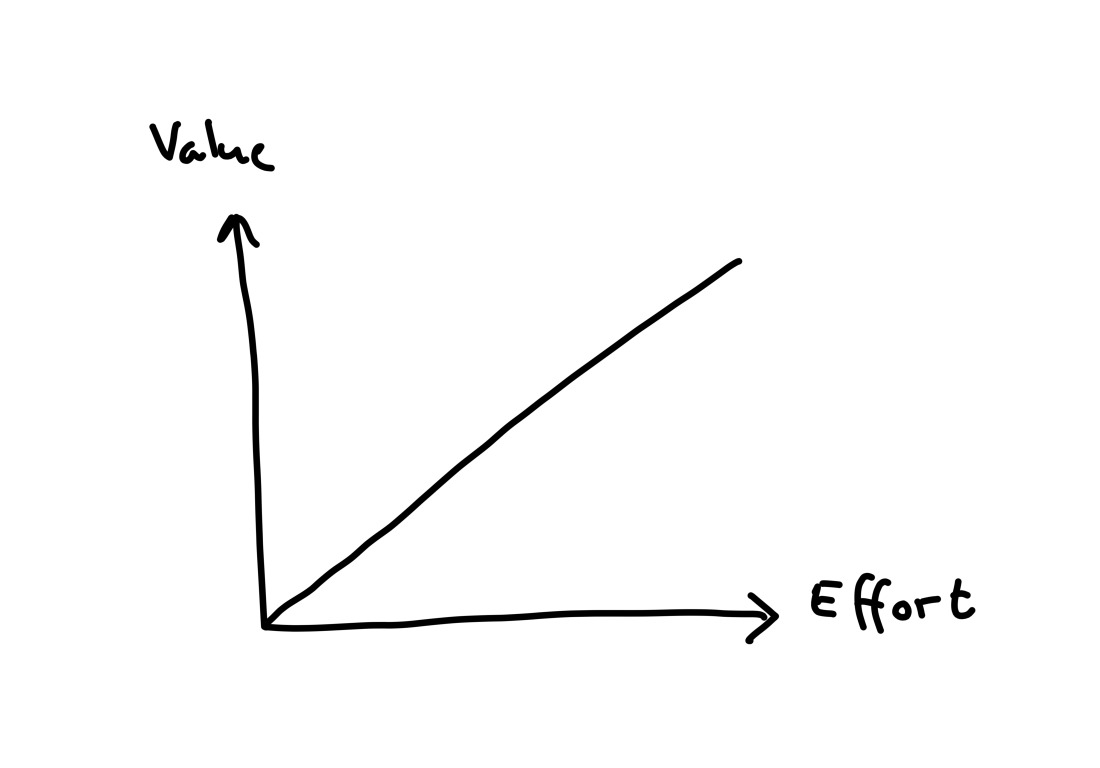
Basically, you add one unit of effort and you get one unit of value out of it. This is a model that works well for some sorts of tasks, like punching holes in a card or getting paid by the hour. Of course, if you start working 14 hour-days, you will not last for long, so the linear function will not be true any more. We understand that of course, and we can still use the linear function as a basis when calculating our pay for a days work.
Here is the Pareto Function:
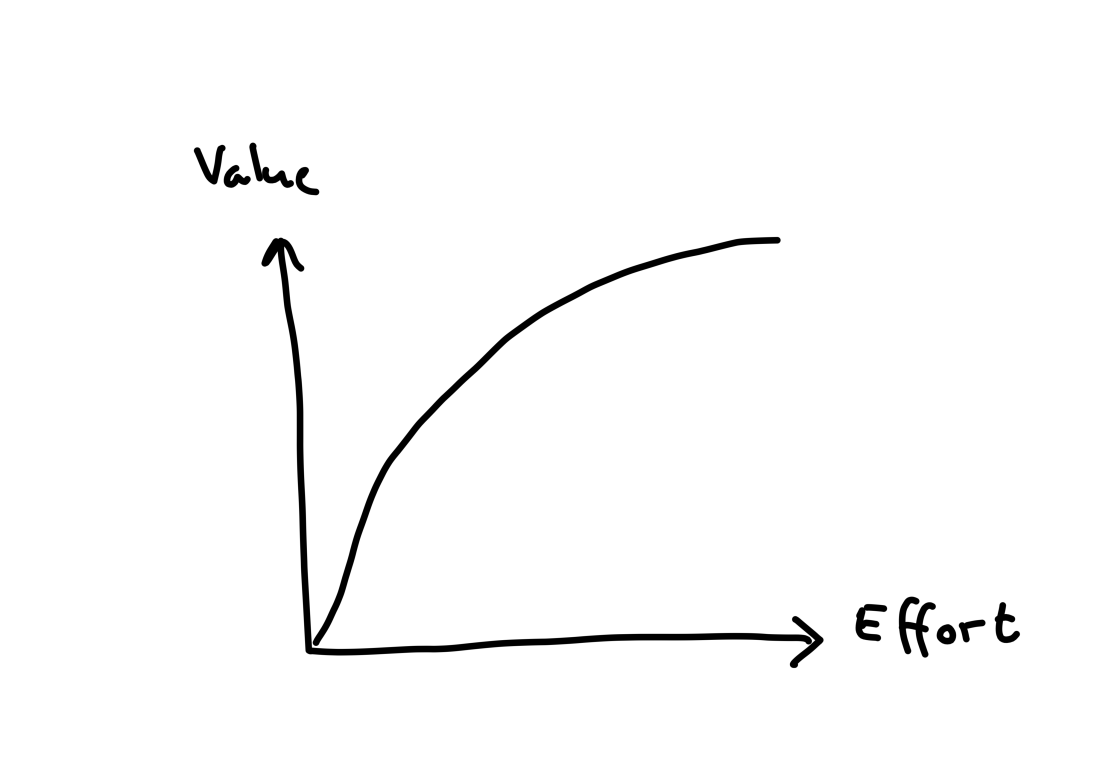
It basically says that you get a lot of value for the first units of effort you put in, but at the end the marginal value for each new unit is close to zero. Eating chocolate follows the pareto function; the first bites are delicious, but the more you eat the less value (joy) you get. In fact, if you eat to much you will get negative value, again reminding us that this is a simplified model of the world.
And finally, here is the exponential function:

It works almost the opposite of the Pareto-function. Here the first units of effort you put in yields little value, while the value per unit of effort increase over time. Reading books follow the Pareto-curve nicely. The more you have read, the larger body of knowledge you have and the more you can connect new ideas to other concept and ideas you have heard before. Of course, if you only read on a narrow set of topics over and over again, you probably don’t get exponential value. Again we understand that, and we understand that this is a model we use to try to make sense of the world, not a fact.
For some reason, the human brain seems to default to the linear function for a lot of things that we don’t intuitively get. Even worse is that it also tends to forget that we are using a model for these unknown things. While everyone understands that eating too much chocolate is bad for you, we don’t have the same natural understanding that adding too many people to a team can have the same effect.
So how many individuals do you need to complete X? In the real world, adding another person to your team can have a number of different outputs. It can 10x the output of the team. It can add basically no extra output. It can slow down the team or even start generating negative value. There is a lot of reading to be done on this, especially within the IT-industry. If we are to use one simplified model though, the Pareto function is more representative than the linear. Adding a team member to your team of four makes a difference. Adding 10 people to your team of 100 doesn’t move the needle much.
And if you are looking into spending money to attract new customers, you need to understand that people do what other people do. Your first customers are worth much more than the average customer value. In fact, if you can reach to a critical point, you don’t need to spend time on marketing any more. You will still grow your customer base. This follows the exponential curve.
Before you start spending money or time on something, define which model you are looking at (these three will take you a long way). For instance, if you are doing a scope-cap estimate to understand how much you can build in your product, you should probably user the pareto function (expect it to be very expensive to reach the last 20%). If you set out to change the culture within the company, expect it to require a lot of work with very little return in the beginning.
And remember that you are using a model. Don’t be surprised when the real world surprises you.

 kombine.blog