Finding Your True Priorities

We’ve spoken before about getting clear on you emails (and everything else). 

Here is a nifty thing to try out. Create a spreadsheet with three columns; 

– What is it?

– Who’s it for?

– What´s it for?

Then, for the upcoming week, log everything you do in this spreadsheet. For every email you read, every email you send, every meeting you attend. Every document you are writing on. Log it all.

By the end of the week, review your table. Can you see who you working for? What you are trying to do?


These are your true priorities. Do they align with the story you tell yourself? The story you tell others? Your role description?


If not – what are you going to do about it?

In Two Weeks from Now

I hate being busy. Working with the urgent, with people depending on me. Waiting on me. 

I slip back into it from time to time. Sometimes because of me, sometimes because of external factors. Some people seem busy all the time though; they never have enough time to properly read and respond to an email, never enough time to reflect or plan or at least to make sure they are busy over the right thing. 

When I find myself stuck in busy, I set aside one hour on where I just focus on my calendar in two weeks from now. What deliverables do I have that week? What commitments to my family? To my team? What do I need to prepare? Who do I need to talk to?

Drafting up this plan is a great feeling – stepping out from the busy if just for one hour. Sure, it won’t help me today, but in two weeks from now it will make all the difference.


What do you do to break that busy loop and making sure you focus on the important, not the urgent?

Before Your Next Email

Ask yourself: 

– Who’s it for?

– What’s if for?

If you can’t answer both of these questions, don’t send it. 

And when you can answer them, use them to craft you message clearly based on the recipient and the message you want to get across.

Too often we do things out of habit, out of a sense of urgency. This results in a lot of bad communication, eating up precious time for both us and our colleagues.

Becoming crystal clear on your intent will take your communication to the next level. Helping others see what you see, where you want to go. And you will likely send less emails along the way. No one will blame you for that. 


PS These questions applies not only to email, but to meetings, presentations, documents, slack-conversations. But you already got that. DS

Managers and Leaders

They are two very different things.

The leader sets the goal, sets the direction to where she wants to go and then she works hard to get people people excited to join the journey with her. The manager on the other hand makes sure it is a smooth ride, removes obstacles along the way and sets the environment so that every team member enjoys the ride and can contribute with her best effort.

Both are needed, but you don’t need to be a great manager to be a great leader. Or vice versa. In our culture, we often look for one person to do both, to be ”the boss”. There are people who are both great leaders and managers, but they are not easy to find.

If you work for a leader who is not a manager, you are likely to hear a lot of vision, be really excited about where you are going, but you may miss structure and find the minutia of your day-to-day job cumbersome and stressful. You may be frustrated knowing where you want to go but not feel that you are progressing.

If you work for a great manager who is not a leader, you are likely to have a structured way of working but you may not be excited or motivated about where you are going. In fact, you may not even know where you are going. You may be frustrated by running around being busy without a sense that you are actually going somewhere.


The world needs both managers and leaders. Are you capable of both? If not, do you know where to seek for help? 

Boss Up

I have heard several managers in short time stating that they need to ”Boss Up”, become more assertive and firm. So they fire off a few emails, make a decisive stand in the next meeting and make it clear that they are the ones making the calls around here. Showing who’s the boss. 

What if Boss Up would mean that you listened more? Connected more? Motivated people to show up and do great work?

It might be worth a try.

ROSA

This one is all about communication, and I couldn’t think of a more suitable post for the time I’ve had the pleasure to work with you Rosa. Thank you for this time – looking forward to more discussions in the future.

I was upset. Even today, 10 years later, I still remember how I struggled to not let my irritation shine through when I explained what I wanted done. I repeated almost the exact same words I had been using for over three weeks now.

I had been in these situations before, and I suspect you have too – a conversation where you agree on something, only to discover later that you agreed on very different things.

This time was different though. It was the third time we checked in only to realize we talked about different things. I had high expectations on the person in front of me, and I knew that he also had set a high bar – both on himself and on his time in the company. I was convinced that he had all the drive and commitment to perform and shine, so this was not out of malice or of laziness that we did not move forward. Something had gone wrong in our communication. The question was what.

My frustration turned into curiosity; Is there any structured way to avoid this? Are there any good templates for conversations that can minimize the risk of obvious misunderstandings? I began to research literature on personal communication and found a couple of models that spoke to me. I quickly realized that misunderstanding is a rule rather than an exception. You have your reality, I have mine. We need a lot of conversation, in-depth and often, to find and maintain a somewhat shared picture between us.

There is a lot of excellent literature and research on communication models, but there is one simple model that has proved to be the most effective for me personally, and for many acquaintances who have tested it. It’s easy to remember, quick to jot down on a paper before or during a conversation, and strikingly effective. I still use it regularly.

Reality check
Objectives
Solutions
Actions

First you do a reality check. Referred to as a check in in some models, this basically means making sure the person you are talking to is actually here with you in this conversation, not having their mind occupied with something else. Showing a bit of empathy goes a long way, and a simple question such as “Hey, how are you, what’s on your mind right now?” can dramatically improve your dialogue.

If you are both present, you can move on to the objectives. We all work with different views of the world, and this step is about finding the objective things you can agree on. Stay objective on the subject, don’t add intent or solutions. Avoid judgement. Things that you can agree on are true. The purpose of this step is to find a shared worldview. If you don’t find that, it doesn’t matter if you agree on a solution – you will solve different things.

Once you have a common worldview, it is time to talk about solutions. Try not to jump here too quickly though; most of us are solution-oriented, and we are happy to talk about solutions we have come up with. It is surprising how fast and how rewarding these discussions on solutions often become if you have done your work on the objectives first.

Once you have a solution, there is one last critical step in defining the concrete actions for moving forward with the solution. Who does what and when? This is ironically often missed, resulting in two persons in total agreement but no one actually doing the stuff they agreed upon. Ending a meeting with a solution is good, but it can quickly backfire the next time you meet when both people thought the other one was going to do stuff to move it forward.

For my next meeting, I quickly jotted down ROSA on a paper note and started over. Turned out his mind was somewhere else completely, and we spent the entire time on that topic instead. When we came to the objectives in our second meeting, it was clear that there were a lot of gaps in terminology, things that I somehow assumed he would know even though he was new to the company. Once we had our shared view, solving and executing on it was a breeze.

Getting good at conversations is a powerful way to improve the quality of work for you and those you interact with. Jotting down these four letters before you enter your next conversation is a good way to start.


Disclaimer: I did not invent this model, but I don’t remember where I got it from. I cannot find it online, so if you know who the creator is, link to it in the comments below and I will update this post with proper credit!

Autonomy in a Box

There really is no other way. You need to define the borders, the boundaries within which you have or give autonomy.

You don’t give someone a car and give them full autonomy. You define the box they are in; which side of the road to drive at, what speed limits are, how to yield at a crossroad. 

Giving someone autonomy without defining the box is either a grandstanding to project an image of a modern workplace, or a recipe for a total disaster. Or sometimes both.

Understanding Value-Effort Models

Life is complex, and the workplace is no different. If you ever had a job, it is likely that you at some point have been asked questions about value and effort. What is the value of a customer? How big of a team do we need? When will this be done? 

In a complex world (the real world, the one we live in), these questions are impossible to answer exactly. To handle this we use simplified models that allows us to give answers to these questions. In fact, most of us use these models so frequently that we tend to not reflect on which model is best suited for the question at hand, or even that we are using a model at all.

There are some really advanced models trying to predict for instance stock markets, but for most situations a basic understanding of three common models will take you a long way. 

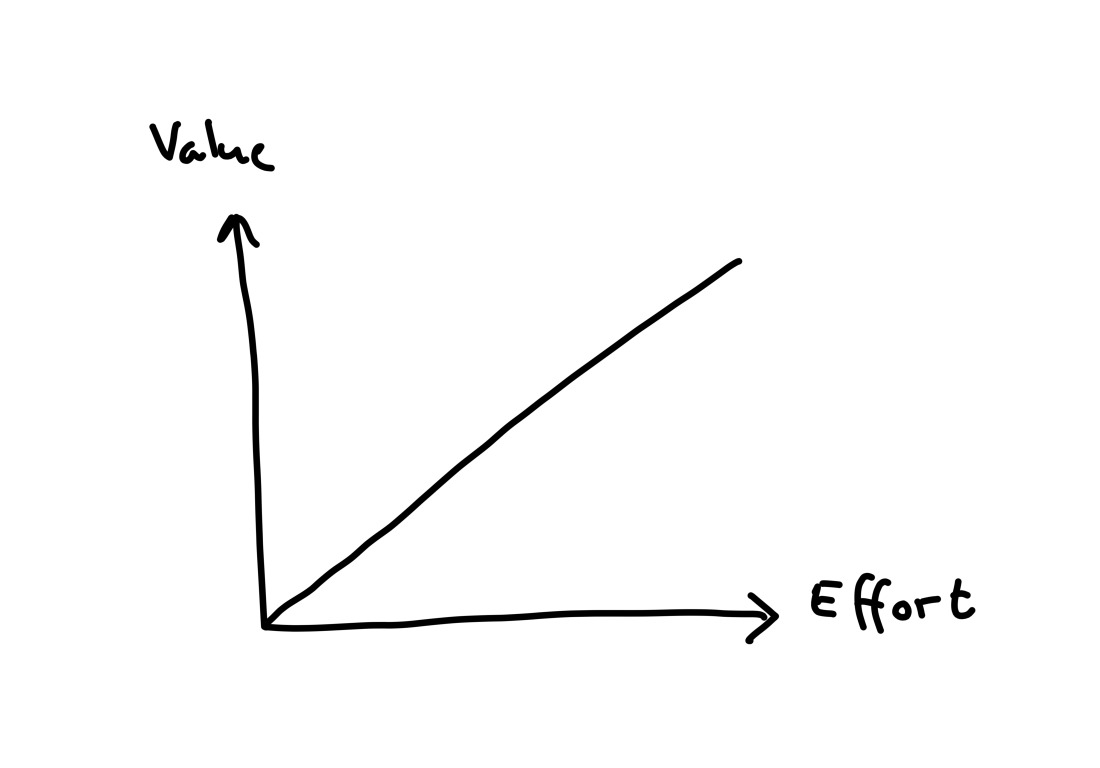
First out is the linear model:

2019-05-17 - Linear.png

Basically, you add one unit of effort and you get one unit of value out of it. This is a model that works well for some sorts of tasks, like punching holes in a card or getting paid by the hour. Of course, if you start working 14 hour-days, you will not last for long, so the linear function will not be true any more. We understand that of course, and we can still use the linear function as a basis when calculating our pay for a days work. 

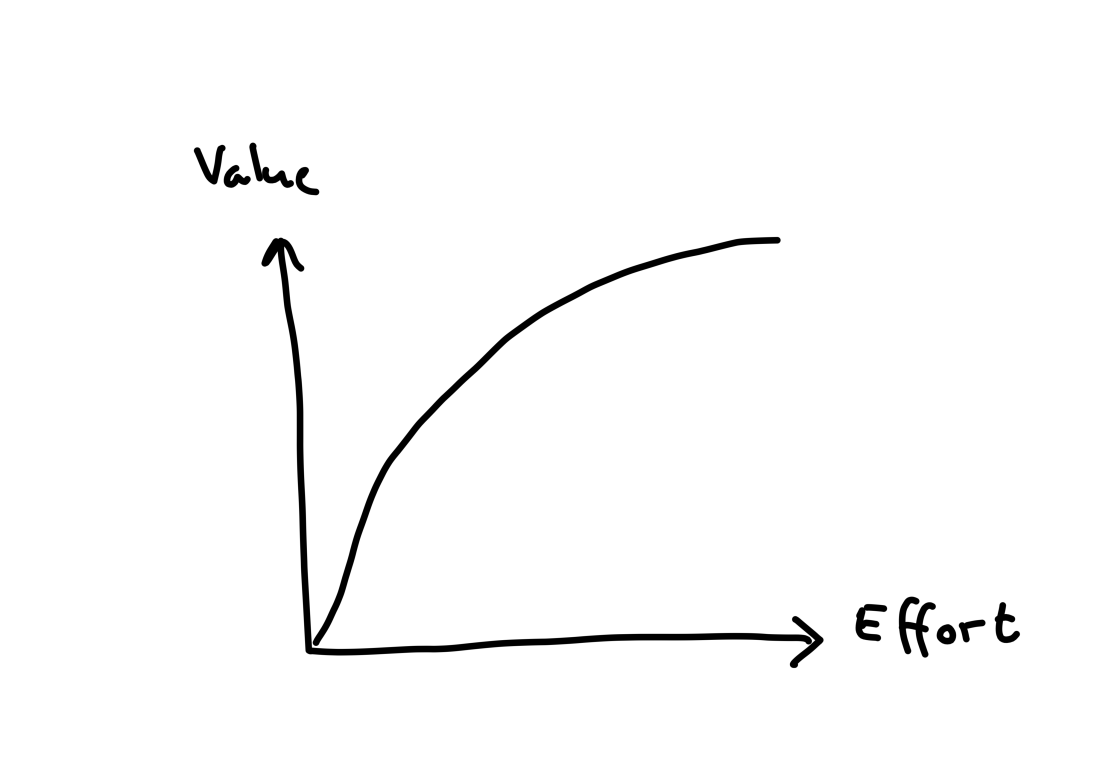
Here is the Pareto Function:

2019-05-17 - Pareto.png

It basically says that you get a lot of value for the first units of effort you put in, but at the end the marginal value for each new unit is close to zero. Eating chocolate follows the pareto function; the first bites are delicious, but the more you eat the less value (joy) you get. In fact, if you eat to much you will get negative value, again reminding us that this is a simplified model of the world.

And finally, here is the exponential function:

2019-05-17 - Exponetial.png

It works almost the opposite of the Pareto-function. Here the first units of effort you put in yields little value, while the value per unit of effort increase over time. Reading books follow the Pareto-curve nicely. The more you have read, the larger body of knowledge you have and the more you can connect new ideas to other concept and ideas you have heard before. Of course, if you only read on a narrow set of topics over and over again, you probably don’t get exponential value. Again we understand that, and we understand that this is a model we use to try to make sense of the world, not a fact.


For some reason, the human brain seems to default to the linear function for a lot of things that we don’t intuitively get. Even worse is that it also tends to forget that we are using a model for these unknown things. While everyone understands that eating too much chocolate is bad for you, we don’t have the same natural understanding that adding too many people to a team can have the same effect.

So how many individuals do you need to complete X? In the real world, adding another person to your team can have a number of different outputs. It can 10x the output of the team. It can add basically no extra output. It can slow down the team or even start generating negative value. There is a lot of reading to be done on this, especially within the IT-industry. If we are to use one simplified model though, the Pareto function is more representative than the linear. Adding a team member to your team of four makes a difference. Adding 10 people to your team of 100 doesn’t move the needle much.

And if you are looking into spending money to attract new customers, you need to understand that people do what other people do. Your first customers are worth much more than the average customer value. In fact, if you can reach to a critical point, you don’t need to spend time on marketing any more. You will still grow your customer base. This follows the exponential curve.

Before you start spending money or time on something, define which model you are looking at (these three will take you a long way). For instance, if you are doing a scope-cap estimate to understand how much you can build in your product, you should probably user the pareto function (expect it to be very expensive to reach the last 20%). If you set out to change the culture within the company, expect it to require a lot of work with very little return in the beginning.

And remember that you are using a model. Don’t be surprised when the real world surprises you.


It’s a Mess – and it’s Ok

Last week I came home to be met by this view:

2019-05-13 - Its a mess.png

My daughter and her friends had decided to bake a cake and things went, well, out of hand. We spent almost two hours cleaning up the kitchen afterwards. And they threw away the cake.

I could have done that cake in 30 minutes. That would have saved me 1,5 hours, and the kids would have eaten cake. But it’s ok. They are just kids, and they need to be given autonomy and try things out their own way in order to grow. The long-term benefit for me is clear – waking up late on a Sunday morning to the smell of a fresh cake straight from the oven.

I hope all parents agree with me so far. But what if we were having people over for dinner that evening? Would it still be ok? And does it matter who were coming over – is it a difference between the parents-in-law or your new colleague?

In work-life, we have an instinct to avoid failure at any cost. Many leaders take care of this by baking the cake themselves. By doing so, however, they never allow for others to learn, to take lead and try things out. If you want to build leaders, if you want to build autonomy, you have to start with trust. You have to learn to live with a little failure now and then.

The key then, is understanding who comes to dinner. When can you allow for growth (and potential failure), and when do you need to bake the cake yourself?